On a well-made wig, the hair matters less than most buyers expect. What decides whether a unit vanishes at the hairline or announces itself from across the room is the lace: the sheer knotted mesh the front hairs are tied into. The trouble is that the three labels you see most often — HD, transparent, and Swiss — get thrown around loosely, and two suppliers can sell very different material under the same word. This is a plain-English guide to what actually differs, and how to choose when you are buying for real clients rather than a photo.
What “lace” really means on a wig
Lace is a fine, breathable net — usually a nylon or polyester mesh — and each front hair is individually hand-tied to it, knot by knot. When people argue about “lace types,” they are usually mixing up two separate questions. The first is how much lace a unit has: a lace-front closure covers only the front hairline, common footprints being 13×4 and 13×6 frontals or 4×4 and 5×5 closures, while 360 and full-lace units extend the knotted area around or across the whole cap for more parting freedom. The second question — the one this guide is about — is what the lace itself is made of and how fine it is. A 13×6 frontal made from coarse lace and one made from ultra-fine lace look nothing alike at the skin, even though the construction size is identical.
HD, transparent, and Swiss: the honest differences
HD lace (short for high-definition) is the thinnest, finest mesh a maker offers. Applied well, it presses almost invisibly into the skin and melts across a wide range of skin tones with little or no tinting. That fineness is also its weakness: it tears more easily, frays sooner at the hairline, and generally carries the highest price. The most important thing to understand is that “HD” is a marketing label, not a regulated standard with a fixed denier. One vendor’s HD can be noticeably heavier than another’s, so the name alone tells you little — you have to judge the actual material in hand.
Transparent lace is a light, near-clear mesh that runs thicker and more forgiving than HD. It survives handling better and usually costs less, which makes it a sensible workhorse. The catch is color: because the mesh is pale rather than tone-matched, it can read slightly gray or ashy against deep skin unless it is tinted with a lace spray or a dusting of foundation before wear. Swiss lace sits in the middle in the best sense — fine enough to look natural, resilient enough to last, and, crucially, typically stocked in a few brown shades (light, medium, dark) so it can be matched to complexion out of the bag. For most sellers it is the safe default.
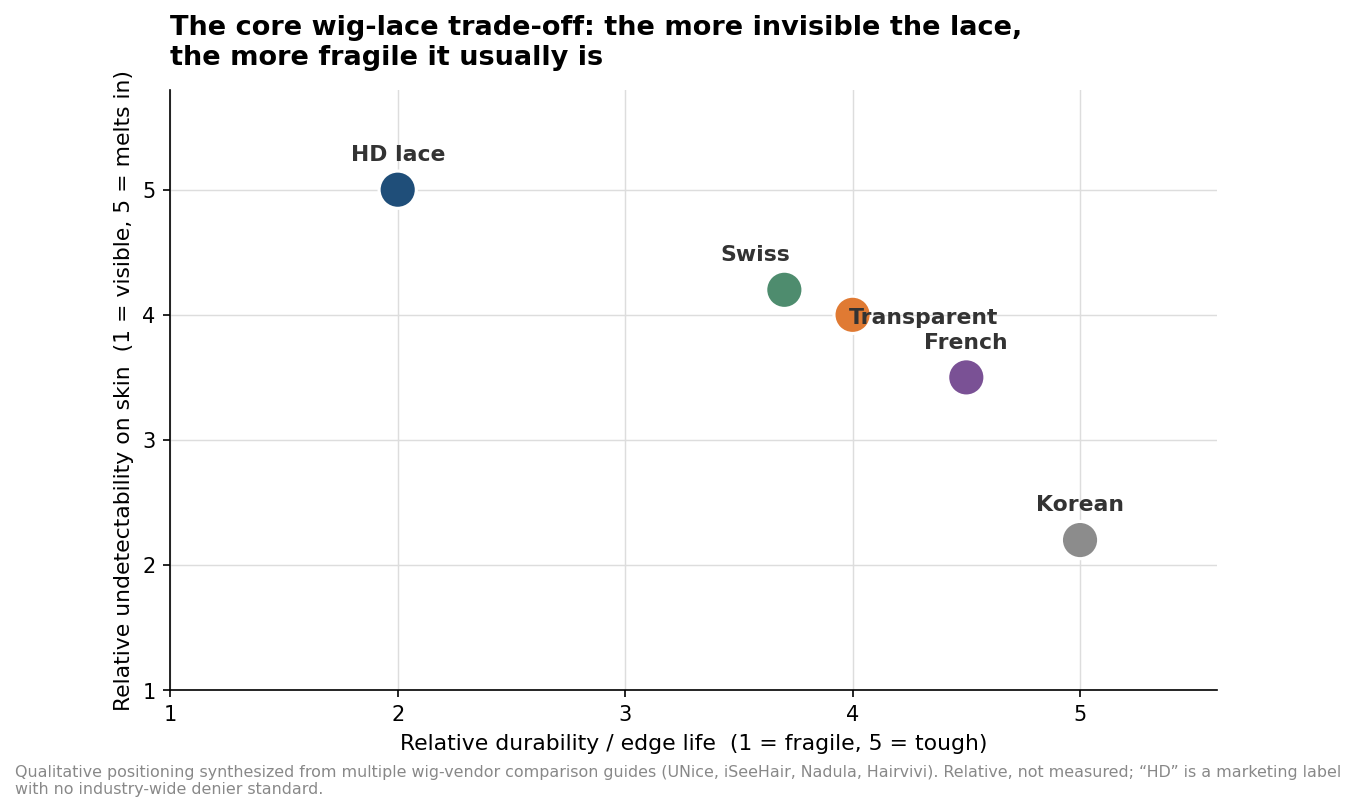
The pattern in that chart is the whole story: undetectability and durability pull against each other. The lace that disappears best is usually the one that wears out first, and the toughest lace is usually the one you can see. There is no cheat around it — only a choice about which end of the trade-off a given client actually needs.
French and Korean lace: the durable, budget end
Two older materials round out the picture and often make more sense than the trendier options. French lace is a touch heavier than Swiss but still looks natural, and its extra toughness makes it a common choice for full-lace units that need to survive frequent restyling. Korean lace is the thickest and stiffest of the group. It is the most visible against skin and the least “melty,” but it is also the most durable and the least expensive, which makes it genuinely useful for practice units, mannequin display heads, theatrical and costume work, or clients who care more about a wig that holds up than about an invisible hairline.
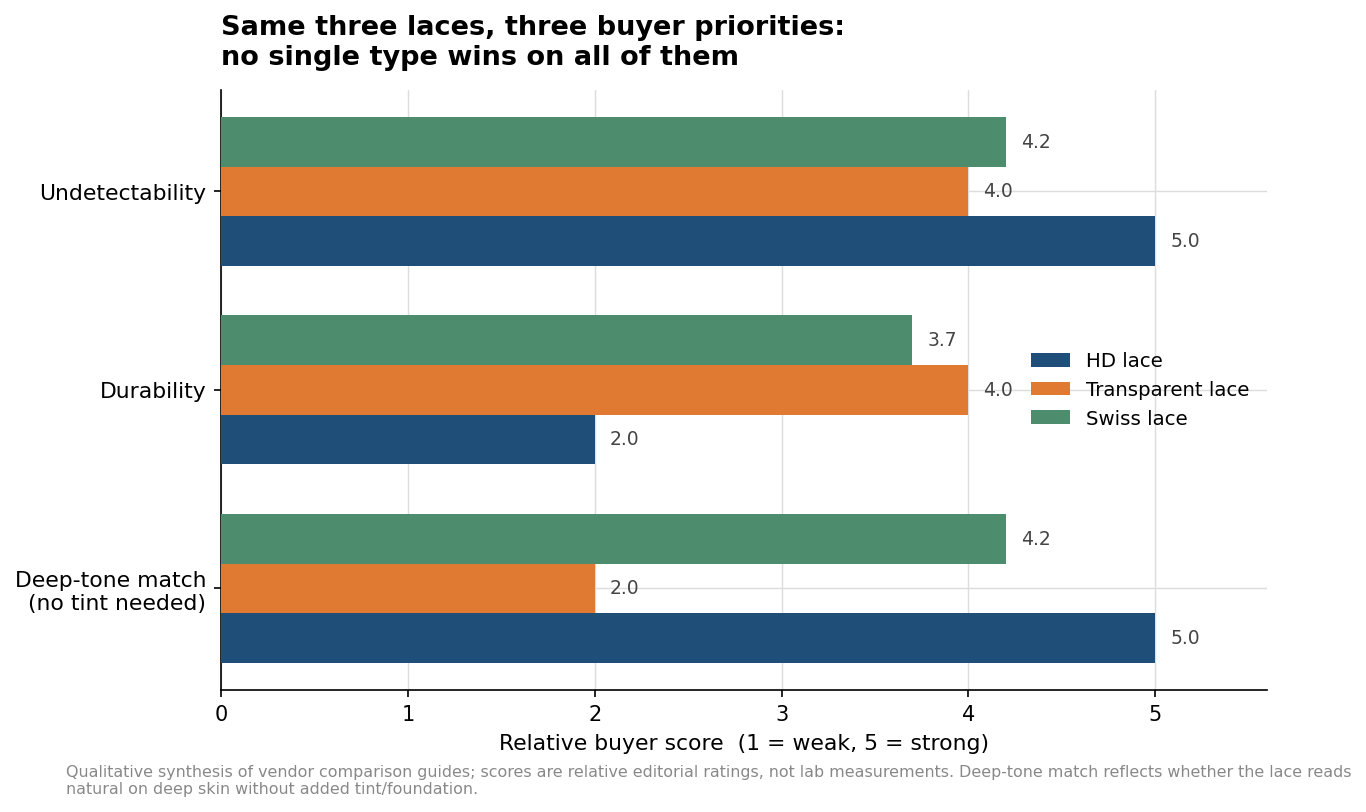
Notice the third bar in that comparison, deep-tone match, because it is the dimension buyers forget. Undetectability in a product photo usually means “photographed on light-to-medium skin.” On deep skin, a pale transparent lace can look grayish until it is tinted, HD tends to melt in across the range, and Swiss earns its keep precisely because it comes pre-matched in browns. If you serve a wide range of complexions, that single factor should weigh heavily in what you stock.
Matching the lace to the client
Work backward from how the wig will be used. For everyday wear, bridal, or anything photographed up close, the invisible hairline is worth the fragility, so a good HD or a well-matched Swiss is the right call. For deep skin tones, lead with Swiss in a dark shade or a transparent lace you are prepared to tint, and be honest with the customer that untinted transparent will need a step before it looks right. For resale or salon stock where a return erodes the whole margin, durability quietly matters more than the marketing, which pushes you toward transparent or Swiss over the most delicate HD. And for theatrical, costume, teaching, or display, Korean lace does the job at the lowest cost and takes abuse the finer laces cannot.
What bulk buyers should actually check
Because “HD” carries no industry standard, treat the label as a starting point and inspect the material yourself: hold it to the light, stretch a corner gently, and confirm that this batch matches the last one. Supplier consistency is the real variable, and it is worth more than any name on the packaging. Think in cost per wear rather than cost per unit — a fragile front that frays in a few months can cost more in replacements and returns than a slightly more visible lace that lasts a year with care. Plan a tinting step for deep-tone transparent units before they reach the customer, and pass on the same care basics you rely on: wash with a sulfate-free shampoo, air-dry, keep tension off the knots, and store on a mannequin, since the hairline is almost always the first thing to fail. With proper care, a quality human-hair unit commonly holds up for several months to a year or more, and the lace you chose at the outset is what decides which end of that range you land on.
None of this makes one lace “best.” It makes the choice a deliberate one: decide whether this particular client is buying an invisible hairline, a hard-wearing unit, or a reliable match for their skin, and let that — not the flashiest label — pick the lace.