Once hair type, length, and density are settled, the next decision on a custom wig order is the lace piece at the front: a closure or a frontal, and in which size. That single choice drives how the finished unit parts, how natural the hairline reads, how many bundles you need to buy alongside it, and a meaningful slice of the unit cost. Getting it right per use case is the difference between a wig that installs cleanly and one that fights the wearer every morning.
What the numbers on a lace piece actually mean
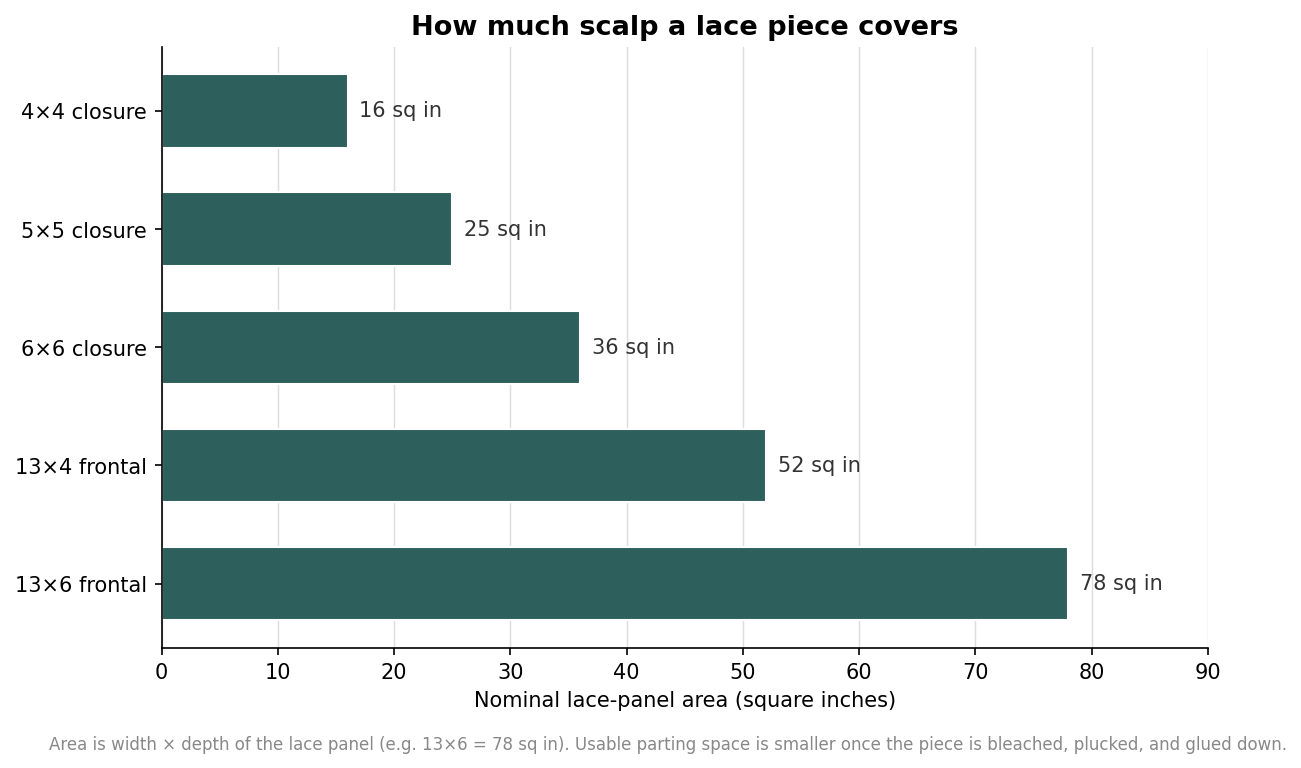
Every closure and frontal is named by its lace dimensions in inches. A 4×4 closure is a four-by-four inch square of lace. A 13×4 frontal is thirteen inches across, spanning roughly ear to ear, by four inches deep from the hairline back. Multiply those out and the coverage gap is stark: a 4×4 closure is about 16 square inches of lace, a 6×6 closure about 36, a 13×4 frontal about 52, and a 13×6 frontal about 78. More lace means more scalp-like area where hair can be parted and more room to hide the transition to the wefts behind it.
Nominal area is not usable area. The panel shrinks in practice once the lace is cut to the hairline, bleached, plucked, and glued down, so treat these figures as relative sizes rather than a promise of parting space. What they reliably tell you is the pecking order, from the compact closure that fixes one parting zone to the ear-to-ear frontal that rebuilds the whole front hairline.
Closures: least lace, lowest cost, fixed parting
A closure sits at the top or crown and closes off the section of the wig where the bundles would otherwise show a visible track. The common sizes are 4×4, 5×5, and 6×6. Because a closure only covers a central patch, it commits the wearer to a parting within that patch. A 4×4 handles a simple middle or modest side part; step up to 5×5 or 6×6 when the client wants a deeper side part or more freedom to move the part around without exposing wefts at the edge.
The tradeoff is cost and versatility against coverage. Closures use the least lace, so they are the most economical front piece and the fastest to install, which makes them the sensible default for everyday units, budget-conscious bulk runs, and wearers who part their hair the same way every day. What a closure cannot do is give an ear-to-ear natural hairline or let the wearer pull the hair straight back off the face, because there is no lace out at the temples to sell that look.
Frontals: an ear-to-ear hairline and real parting freedom
A frontal runs the full front of the head from ear to ear, which is why it recreates an entire hairline rather than a single parting zone. The decision inside the frontal category is 13×4 versus 13×6. Both are thirteen inches wide; the second number is how far back the lace extends. A 13×4 gives about four inches of depth and comfortably handles center and basic side parts up to roughly two inches from center. A 13×6 adds two more inches of depth, about 50 percent more parting space, which opens up deep side parts out to around four inches from center, zigzag parts, and pulled-back styles.
That freedom carries a price. Industry pricing for a 13×6 frontal typically runs on the order of 75 to 100 dollars above a comparable 13×4, reflecting the extra hand-tied lace. Choose 13×4 for a natural front at the best frontal price when the wearer parts within a couple of inches of center. Reach for 13×6 when the order is for versatile styling, deep side parts, or clients who want to change their look without changing units. Figures here are indicative market ranges and will move with hair grade and vendor.
360 lace and when the whole perimeter matters
A 360 frontal wraps lace around the entire perimeter of the head rather than just the front. It exists for one specific promise: the wearer can pull the hair into a high ponytail or an updo and still show a lace-backed, scalp-like edge all the way around. If a client’s core requirement is off-the-face styling and updos, the 360 is the piece built for it, and neither a closure nor a standard frontal will fake that convincingly. For any order where the hair lives down and forward, a 360 is more lace, more cost, and more install time than the look requires.
Matching the piece to the order and the bundle math
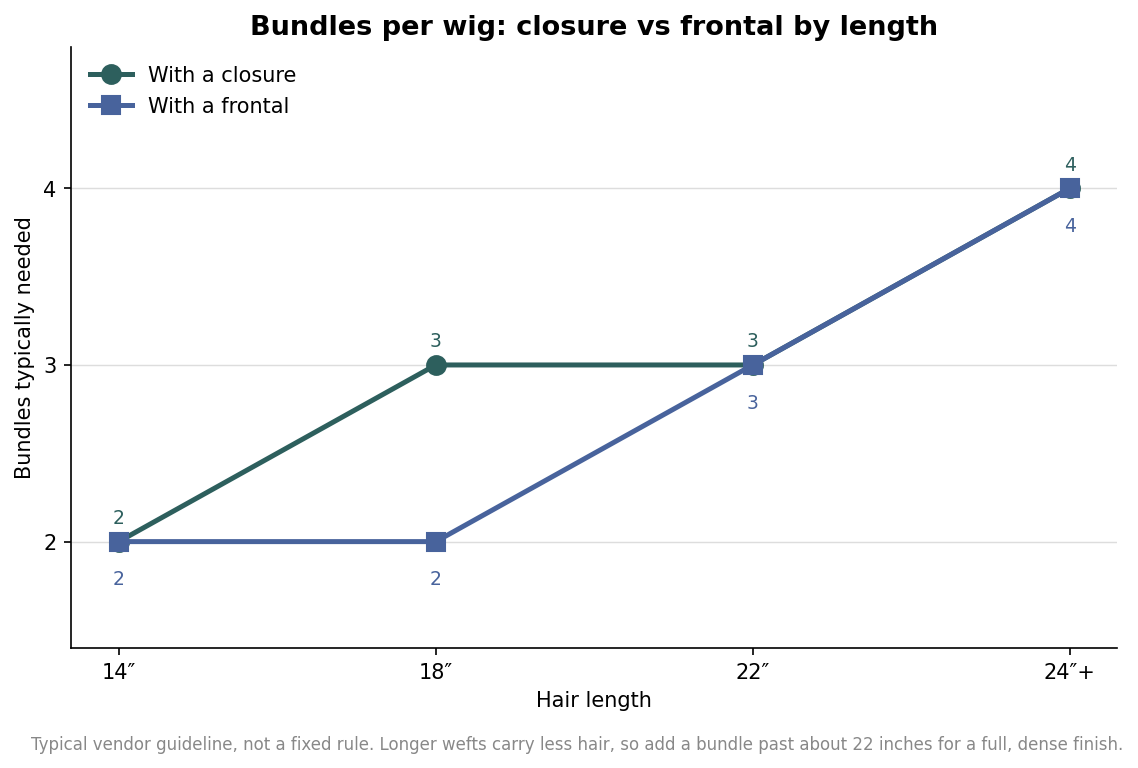
The lace piece also sets how much hair you buy with it, because coverage changes how many wefts you need. With a closure, a common guideline is two bundles for lengths up to about 14 inches, three bundles in the 16 to 22 inch range, and four at 24 inches and beyond. A frontal, covering more of the front, often needs one fewer bundle at short and mid lengths, holding at two bundles through roughly 18 inches before climbing. The reason longer hair still needs more is physical: wefts get shorter as the hair gets longer, so the same weft carries less hair and fullness has to come from extra bundles.
Put together, the selection logic is straightforward. For an economical everyday unit with a consistent part, spec a closure and size it to how far off-center the wearer goes. For a natural ear-to-ear hairline, spec a 13×4 frontal, and upgrade to 13×6 only when deep parting and styling range justify the premium. For ponytails and updos, spec a 360. Then set the bundle count from the piece and the length, add a bundle past 22 inches for density, and the order sheet writes itself. Nail the front piece to the actual use case and everything downstream, cost, install time, and the wearer’s daily experience, falls into line.